
Income & program eligibility
Income you can verify, eligibility you can defend
Income eligibility screening software has one job: get the number right and show where it came from. Need Navigator records every income source with proof attached, keeps staff-verified amounts clearly apart from self-reported ones, and checks whole households against federal poverty level (FPL) and area median income (AMI) limits by year, geography, and household size.
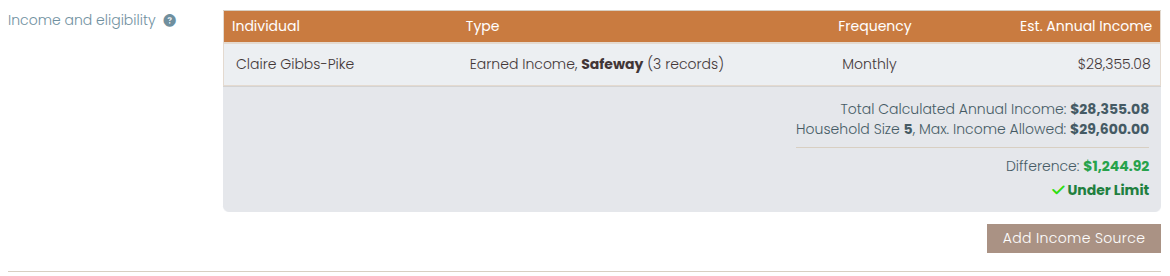
What the income & eligibility module does
Every source, with the proof attached
Record each income source (type, employer, current or past) with per-pay-period amounts. Staff attach proof to the record as they go: a paystub photo or PDF, snapped directly on a phone at the desk or in the field.
A wizard that asks the next question
Guided income capture walks an applicant through each source step by step, on a phone, in English or Spanish. It starts with "Does this person have income?" Answering no records an explicit no-income declaration, clearly different from a question that was never asked.
Verified means a staff member said so
Income from a public form lands on the record marked unverified until a staff member confirms it, and only staff-verified income counts toward eligibility, the client's and every household member's alike. Where each amount came from stays visible on the profile.
Annualized without a calculator
Each source projects to an annual figure, per source and per household, and household income rolls up automatically across members. Minors' income is counted only where a program says so.
Limits the way your funders write them
Set income thresholds by year, type (FPL or AMI), geographic area (metro area, Continuum of Care (CoC) region, county, or state), and household size, with a percentage multiplier. Programs combine income rules with age ranges and required fields, and show clients as eligible or partially eligible.
New year, one step
When the new figures publish, a bulk tool generates next year's thresholds from the current year's. No re-keying every combination of program, area, and household size.
The math prints on the request
Financial-assistance requests pull the household's recent income, within a tracking window you configure, and compare it to the program's maximum allowed income right on the printable request. The reviewer and the file both get the same answer.
One application, the whole household
A single public submission can capture income for several household members at once. Staff review each person and each amount before anything counts; nothing links to a record without confirmation.
Questions agencies ask
What is the difference between verified and self-reported income?
Self-reported income is what a client or applicant entered themselves, on a public application or through the guided income wizard, and it arrives on the record marked unverified. A staff member confirms the amount before it counts, attaching proof (a paystub photo or PDF) to the record as they go. The distinction is enforced, not just displayed: a client's own income must be staff-verified before the eligibility engine counts it, and where each amount came from stays visible on the profile.
What is the difference between FPL and AMI?
The federal poverty level (FPL) is a set of income thresholds published nationally each year by household size; area median income (AMI) is the midpoint household income for a specific geographic area, so it reflects local conditions. Different funding sources screen against different standards: one program may use a percentage of FPL while a housing program uses a percentage of AMI. Need Navigator stores both threshold types, by year, geographic area, and household size, with a percentage multiplier, so each program checks against the standard its funding actually uses.
What happens when income limits change each year?
Thresholds are stored by year, and a bulk tool generates the next year's thresholds from the current year's. That means annual updates are one step, not an afternoon of re-keying every combination of program, threshold type, area, and household size.
Does a minor's income count toward eligibility?
Only when a program says it should. Household income rolls up automatically across members for eligibility, and each program controls whether minors' income is included in that roll-up. A teenager's part-time job counts toward a program whose rules require it and stays out of one whose rules do not, without staff doing side math.
Can one application capture income for the whole household?
Yes. A single public submission can capture income for multiple household members, each source recorded per person through the guided wizard. Everything arrives marked unverified; staff review the submission, match or create each member, and confirm the amounts before anything counts toward eligibility.
Screen a household against your limits
Bring one program's income limit to the demo; we will set up the threshold, walk an application through guided income capture, and print the request that shows the math.