
For community action agencies
Eligibility you can document, dollars you can trace
Case management software for community action agencies gets tested twice: once at intake, and again when the monitor visits. Need Navigator screens households against federal poverty level (FPL) and area median income (AMI) guidelines, keeps staff-verified income apart from self-reported, tracks every assistance dollar to the penny by funder, and holds the audit trail that backs it all up.
Built for the way community action runs
Six workflows every community action agency carries, and how Need Navigator handles them.
Eligibility against FPL and AMI
Set income thresholds by year, type (FPL or AMI), geographic area, and household size, with a percentage multiplier per program. Programs combine income rules with age ranges and field rules, clients show as eligible or partially eligible, and a bulk tool generates next year's thresholds from this year's.
Income you can stand behind
Income sources carry proof (a pay-stub photo or PDF, snapped on a phone), and the system enforces the line between staff-verified and self-reported amounts. Income from a public application arrives marked unverified and does not count toward eligibility until a staff member confirms it. Household income rolls up automatically.
Assistance tracked to the penny
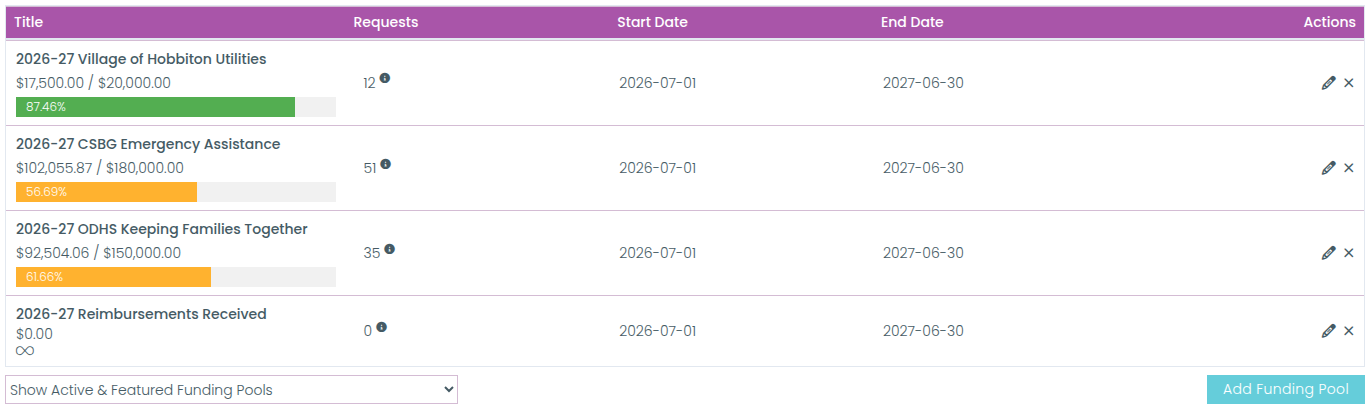
Requests move through a clear status ladder: pending, ready for review, approved, finalized, voucher printed. Supervisors have a queue, not a pile. Funding pools carry balances and date ranges by funder or program, one request can split across pools, and the system warns when allocations do not add up. The eligibility math prints right on the voucher.
Programs with real enrollment history
Enrollment episodes keep entry and exit dates, who enrolled and exited the client, and, where configured, agency-defined exit reasons grouped into categories. Each program's homepage shows enrollment counts, retention, resources distributed, and dollars disbursed: the shape of the program at a glance.
Reporting that follows the grant
Break demographics down by race, ethnicity, gender, language, and ZIP, the kind of breakdowns that support Community Services Block Grant (CSBG)-style funder reporting. Schedule delivery weekly or monthly, done before anyone asks. Per-report redaction levels keep personally identifiable information (PII) out of a board packet, and everything exports to Excel.
Ready for the monitor's visit
Every create, update, delete, and client-record view is logged (who, when, from where), and toggleable rules flag unusual access patterns for administrators to review. When a monitor asks who touched a record, the answer is a filter, not a hunt, and access logs export to CSV.
Questions community action agencies ask
How does the eligibility engine work?
You load income thresholds by year, type, geographic area, and household size, with a percentage multiplier for programs set at, say, 125 percent of poverty. The type is either federal poverty level (FPL) or area median income (AMI). Programs combine income rules with age ranges and required-field rules, and clients show as eligible or partially eligible. When new guidelines publish, a bulk tool generates next year's thresholds from the current year's.
We braid funding from several sources. Can it keep them straight?
Yes. Funding pools carry a budget, a date range, and the funder organization or program they belong to, and a single assistance request can split across multiple pools. The system warns when the allocations do not add up to the request amount. Spending and remaining balances report by funder, so you always know whose dollars went where.
Will it handle our CSBG reporting?
The Community Services Block Grant (CSBG) is the funding stream most community action agencies report against, and Need Navigator's demographic and spending breakdowns are built with that kind of reporting in mind. There are no pre-built federal report templates. You assemble reports in the flexible report builder and export them to Excel. The system supports your funder reporting; it does not make compliance claims on your behalf.
Is our data separate from other agencies?
Yes. Each agency runs its own copy of Need Navigator with its own private database. There is no shared tenancy, and cross-agency queries are impossible by construction. Client data is encrypted at rest on the application server, and every client database is backed up nightly to redundant, encrypted cloud storage with integrity verification on every run.
See it with your income guidelines in hand
Bring this year's guidelines and the funder report you dread. We will build a program's eligibility rules live and walk an assistance request from intake to printed voucher.